

An Acquired Arboreal Acquaintance
Tree Tag #652 on Baylor's Sustainability Map
By Samson Colburn for Dr. Joshua King's ENG 2301: British Literature class, Fall 2025
This reflection is part of a series of “Tree Stories” by Baylor students that take root in their observations about a tree on campus, branch into connections between their tree and their experiences and education, and leaf out into a creative response to the tree.
Welcome
The following story is a creative reflection of my experiences with this tree including how my faith has influenced my view of nature. It also serves as a reflection of the stories that were discussed in ENG 2301 and how they influenced my views of #652 and even trees and nature in general.
Roots
Tree #652 is a live oak tree located on 3rd Street next to the Albritton House on the east side (towards the Foster Business Center). This tree first caught my attention early in my freshman year at Baylor. I would often pass the tree on my way from Teal Residential College (in East Village) to classes in buildings such as Sid Rich or Old Main. The reason I noticed it apart from the other trees on campus was due to its low-hanging branch on the east side. This branch allows easy access to climb into the tree, which I have done on several occasions throughout the last 4 years I have spent at Baylor.
Live oak trees – “quercus virginiana” in Latin – are native to the Southeastern region of the of the United States, and they are characterized as evergreen trees with large structures and low-hanging branches. Live oaks typically grow to be about 50 feet tall and can be more than 4 feet in diameter and 100 feet in total spread. However, #652 is a little smaller at about 25 feet tall and 26 inches in diameter with a crown spread of 50 feet. Historically, live oak trees were used by shipbuilders since these trees are known to have very strong limbs (Trees of Texas). This fact really connected with me because even Swedish merchants and travelers in the late 19th century, such as my ancestors that ended up staying in America, strongly desired this wood for their ships and would trade with Americans for it.
Branches
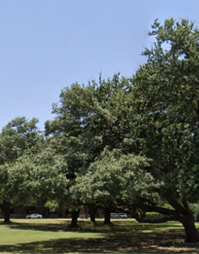
Very soon after I arrived at Baylor, #652 caught my eye because of its prominent low-hanging branch. So, every so often, I would take some time to climb into the tree and relax from other work, especially if I was feeling anxious. I would typically do this in the evenings, when a few stars can be seen despite the light pollution of Waco. In fact, the second image below was taken from up in the tree just after sunset. I use these times to notice creation and remember that God is in control of all of it.
Christina Rosetti describes her experiences with her pine tree when she says “so often have I watched it” (“A Dumb Friend,” Line 17) and been next to it that “now it seems a very friend to me” (Line 19). Like Rosetti, I have found comfort in #652 even though I know it cannot reciprocate these feelings, and I will continue to admire it. In some ways, it feels like just spending time with this tree has made me grow attached to it as a sort of friend. Although I do not visit #652 at noon – I mostly go in the evenings – I empathize with Rosetti when she speaks of her “tree of evergreen” (Line 6) and the times of “the noontide hear [when] it spread a screen whereunder I might sit” (Line 7). Tree #652 is also an evergreen, but it is a live oak compared to Rosseti’s pine tree, and I would often sit in the shade of its branches. Since the summer, I have continued to visit the tree, though not as often, because I feel that I have grown attached to it on some emotional level from all the pleasant memories of the times when I could just relax under it and observe nature.
In Paradise Lost, Milton writes from Satan’s perspective that trees “grew insuperable highth of loftiest shade” (Book IV, Lines 137-138). This imagery describes #652, and live oaks in general, very well. They tend to be tall trees, and their large crown spread provides ample shade for the ground and beings below. Such imagery continues where the trees in the Garden of Eden are portrayed as providing “shade above shade” with a “theater of stateliest view” (Book IV, Lines 141-142). This majestic description further emphasizes the grand size of the trees in the passage and could similarly represent the size of live oak trees.
Whether through a divine interpretation or a more personal sense of relationship, these authors have found some type of connections with their respective plants. In essence, spending time with this tree is a good reminder for me of the divine qualities that God bestowed upon his creation to remind us of who He is and that He cares for us.
Leaves
Introduction
Here, I have written a poem about Tree #652. The format is inspired by Christina Rosetti’s poem “‘All Thy Works Praise Thee, O Lord’: A Processional of Creation,” which contains many short stanzas from different perspectives. Similarly, my poem starts with 2 stanzas from my own point-of-view, followed by 2 stanzas from the tree, and finally 2 stanzas with God as the narrator. I feel that this form truly encapsulates my familiarity with this tree since most of my time near it is spent thinking about nature and God.
Creative Response
An Acquired Arboreal Acquaintance
Works Cited
Sustainability | Baylor University, sustainability.web.baylor.edu/. Accessed 15 Oct. 2025.
Texas A&M Forest Service - Trees of Texas - List of Trees, texastreeid.tamu.edu/content/TreeDetails/?id=109. Accessed 14 Oct. 2025.
“Plant Database.” Lady Bird Johnson Wildflower Center - The University of Texas at Austin, www.wildflower.org/plants/result.php?id_plant=QUVI. Accessed 14 Oct. 2025.
Milton, John. “Paradise Lost”
Rosetti, Christina. “A Dumb Friend”