

Coat of Arms
Tree Tag #108 on Baylor's Sustainability Map
By Joshua Bender for Dr. Joshua King's ENG 2301: British Literature class, Fall 2025
This reflection is part of a series of “Tree Stories” by Baylor students that take root in their observations about a tree on campus, branch into connections between their tree and their experiences and education, and leaf out into a creative response to the tree.
Welcome
My tree is a Carya illinoiensis, also known as a pecan tree. It sits behind the Baylor Science Building in an open field. It has two main trunks that branch from a foot or two from the base. There is a smaller tree sitting close by that looks like my tree is protecting. During the transition into winter, my tree was the only one with leaves until they fell just like the rest of the nearby trees. The name of this reflection as Coat of Arms bears relevance in that it is protecting the smaller tree from protection similar to a coat, and that it has two trunks sticking out similar to arms.
Roots
The reason I chose this pecan tree is that it is on the way to my classes in the science building. I remember fondly coming out of an ecology class talking about plants and looking at that tree as an example. It is somewhat alone in the middle of a grass field, except for a smaller tree directly next to it. This gives it an illusion of aiming to protect the smaller tree from harm. It also greatly changes the view of the tree while standing nearby. Due to the somewhat empty surroundings, the tree seems even taller than its actual height of 50ft with a crown spread of 80ft. This connects to one of the readings from class this year by Hone Tuwhare called “No Ordinary Sun.” This short poem advocates for stopping nuclear weapon testing in Polynesia. This reminds me of that by its loneliness of not having many other trees nearby, just like the example tree in that poem. Another reason for my choice of tree was its differing shape from the normal tree. It breaks off its main trunk into two distinct “arms” that break off into smaller branches. By using the Texas of Trees website, I found that the pecan tree is native to the Southern United States and northern Mexico. It is even the state tree of Texas.
Branches
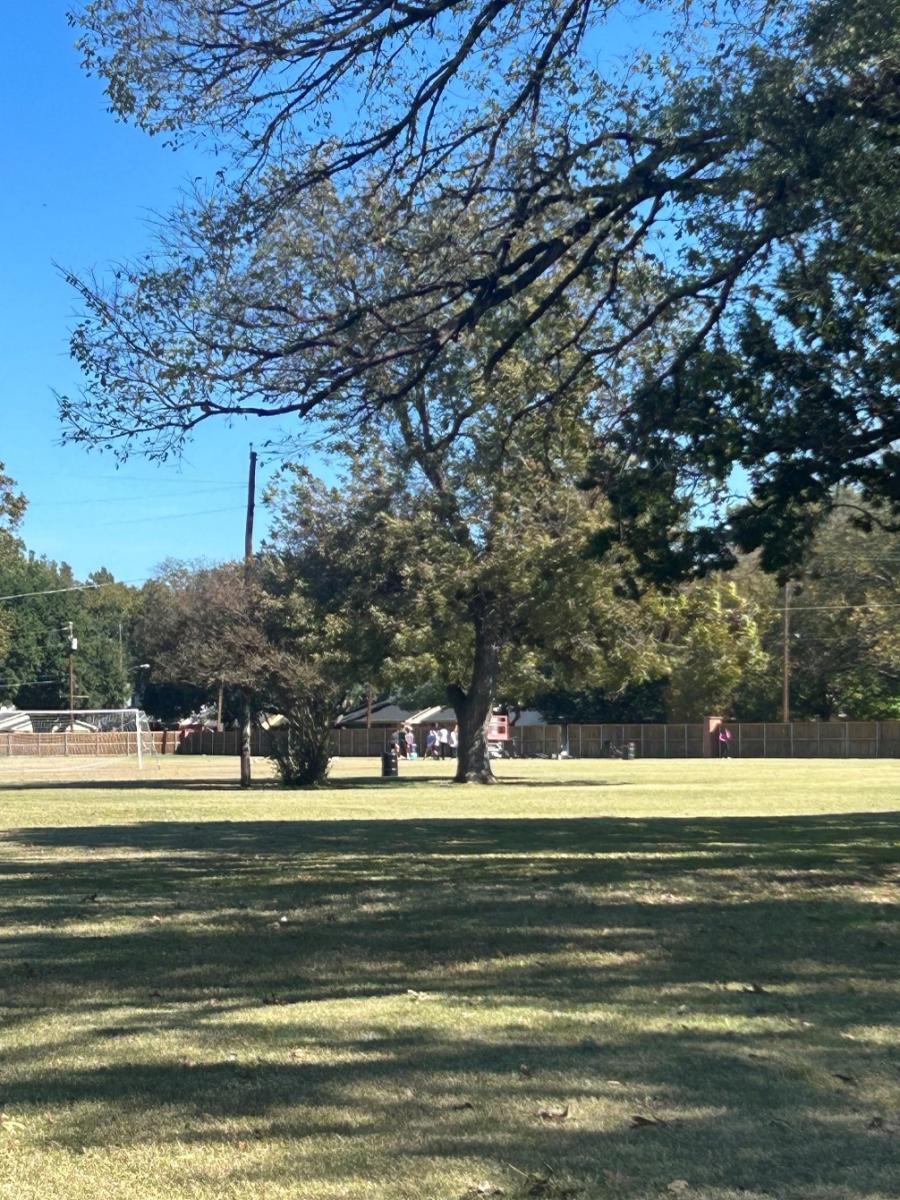
My most memorable moment visiting this tree during the semester was during the transition from fall into winter. I was walking to class on a dirt path relatively close to the tree. It was a fairly windy day. This caused dirt from the path to be blown into the air, making it very dusty. It was similar to the visibility level when it is foggy. This reminded me of when my father and I took a vacation to Ireland. During this trip, I wanted to visit the Cliffs of Moher. During the ride over, it began to become very foggy the closer we got. By the time we had arrived, it was pretty difficult to see very far in front of me. The visible range was around 200ft in all directions. After 30 minutes had passed, it got so bad that it was difficult to see 50ft. Even with all the fog, it was still one of my favorite memories from the trip. The dust from the wind kicked into the air and clouded my vision of the tree, reminding me of that day. When I looked upon the tree that day, I noticed that it was the only one around that still had leaves. This was surprising to me as I knew that pecan trees would lose their leaves for the winter. This image stuck with me and reminded me of another author we have read in this class. “Our Casuarina Tree” by Toru Dutt remarks about a Casuarina Tree that she remembers from her life, and the distinct memories formed with it. Whenever she comes across this tree, it reminds her of the memories she had made while she was younger. In this poem, it states how “No other tree can live” (line 5) and how “The flowers are hung in crimson colors all the boughs among.” (lines 6-7) This reminds me of this moment because all the other trees’ branches, or “boughs,” were littered with their fallen leaves, or “flowers,” in “crimson colors.” This contrasts with my pecan tree, which stands tall in the face of winter. After a few days, my tree had also succumbed to the winter’s onslaught and has also lost its leaves. Even without the tree’s mighty leaves, it was still very grandiose and marveled over everything nearby. This picture was from earlier in the year when the surrounding area was filled with color. I chose to include this because it shows what the tree looks like at its peak, and not almost dead.
Leaves
Introduction
For my creative response, I chose to do a musical composition. I chose this avenue because I believe it can best represent the emotions that I want to incite. Rather than just saying it is winter, I can convey this much easier and to greater effect within the music I have composed. I have conveyed this by setting half the piece into concert F and Bb minor. This gives off the feeling of death and decomposition that comes with winter. This is also inspired by Toru Dutt and “Our Casuarina Tree.” The second half of the piece bears an idea of the grandiose nature of my chosen tree. I have implemented the second part to be similar in feeling to a fanfare, to represent this. I have also moved the piece from Bb minor to its major correspondence of Db major. This changes the idea from the idea that the tree is dying from winter into the idea that it is this massive object that should be praised and celebrated. I even implemented a small motif from The Lion King as a nod that it is the largest tree around and therefore is the “king” of the surrounding area and should be celebrated with a fanfare.
Creative Response
Works Cited
Texas A&M Forest Service - Trees of Texas - List of Trees, texastreeid.tamu.edu/content/TreeDetails/?id=22. Accessed 14 Oct. 2025.
“Sustainability Map.” Baylor.edu, 2025, sustainability.web.baylor.edu/sustainability-map/sustainability-map.
Dutt, Toru. “Our Casuarina Tree.”
Hone Tuwhare. “No Ordinary Sun.”