

Dual Existence
Tree Tag #3116 on Baylor's Sustainability Map
By Ben Templet for Dr. Joshua King's ENG 2301: British Literature class, Fall 2025
This reflection is part of a series of “Tree Stories” by Baylor students that take root in their observations about a tree on campus, branch into connections between their tree and their experiences and education, and leaf out into a creative response to the tree.
Welcome
In this story, I invite you to sit beneath my great American Elm and see it as more than just a tree on campus. Through its dualistic features, I explore how nature reflects both God’s generosity and our tendency to overlook His creation. My hope is to encourage you to view trees and nature more broadly not as a tool to take advantage of, but rather as an instrument to praise God’s creation.
Roots
My tree is an American Elm that stands between the bridge leading to Brooks College and the SUB. I first noticed it not because of its grand stature, its expanding branches, nor its differing leaves, but because of the way that the trunk is seemingly split and still part of one tree. From the same base, two trunks emerge and produce quite different results. The left trunk reaches high towards the heavens with its branches expanding far and the leaves being quite sparsely placed, while the right trunk only reaches about half the height of the other, has much stubbier branches, and yields densely packed, greener leaves.
After some research on this species of Elm, I found that these trees have played a significant role in American History, and have experienced significant hardships. The American Elm is native to the Midwest and Northeast regions of the United States, and are often found lining the streets and parks of cities and towns in these regions, providing ample shade for those who walk beneath them (Young). Sadly, many of these trees were wiped out when Dutch Elm Disease spread throughout the United States in the early 20th century (Young). Knowing this, the Elm that I chose feels like a survivor and a memorial simultaneously, symbolizing both communal strength and sudden loss.
Branches
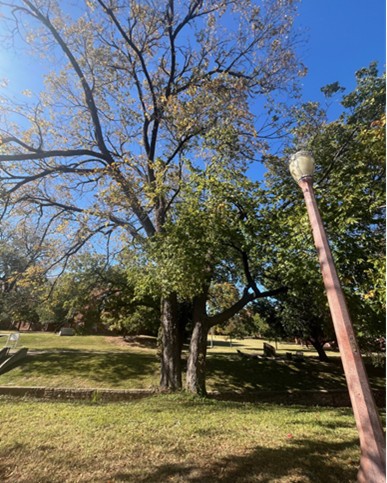
One afternoon as I was headed back to my apartment after a long day of classes, I decided to sit beneath my tree and simply see where my mind took me. As I sat, felt, and observed, I was very drawn to the sort of dual nature the tree possessed. I thought to myself, “How can one tree contain such stark differences in its form, and what symbolic takeaways can I make from this.”
After this experience, I found Milton’s Paradise Lost continually echoing in my mind, specifically the depiction of the Trees of Life and Knowledge in Eden. Milton describes the Tree of Life standing “High eminent” with the Tree of Knowledge growing near it, both life and death growing in the same soil (Milton IV.219). Though my Elm is not in Eden, its split form helps me picture a similar human tension, building on the idea of duality I had begun to notice in my time spent with the tree. The left trunk, reaching towards the sky and thinner in leaves, feels like humanity’s attempt to lean towards what is ultimately good. The right trunk, full and more comfortable, suggests the wanting to settle into what feels more pleasant, even when it furthers us from God’s ultimate good.
Not too long ago, a group of friends and I set out on a trip to Hot Springs, Arkansas where we camped for two nights and went on a 13 mile hike through a seemingly never-ending forest. While on this hike, gazing off into the endless sea of trees, I kept thinking to myself “We need nature, but nature does not need us. The Lord has blessed us with all of this natural life, and we continue to exploit it.” I then thought back to my elm and how this sentiment could apply to it. Ultimately, I came back to the idea of duality, though now with a focus on how humanity and nature can coexist, a dual existence if you will.
As I explored this thought, my mind was brought back to one of the first readings of the semester, The Dream of The Rood. In the poem, the Rood is not only a radiant symbol, but a tree that has suffered via human hands. The tree says that “strong hands seized me, hewed me to the ground with axes,” and later that “they bore me on their shoulders” to become the instrument of Christ’s death (The Dream of The Rood). In this suffering, I think broadly about how we as humans interact with nature. To inflict pain and destruction of what God has created and so graciously given us is, in my mind, spitting in His face. All things are created in His image, and to treat his creation as it were nothing is to not truly appreciate Him.
Leaves
Introduction
These two poems are based on the same tension I explored in the branching section: the desire to see nature not merely as scenery or a means to an end, but as a living witness to God’s presence and to our relationship with him. The first poem invokes the voice and shape that Milton uses in Paradise Lost to imagine my Elm as a small echo of his depiction of Eden. His language often reveals creation as full of God’s delight. Hills, rivers, trees, all bearing His good intention. Writing in Milton’s voice allowed me to express how even my elm, rooted in ground that people often disregard, can become a place of praise.
The second poem shifts back to the tree itself, returning to the theme of dual existence through the suffering and restoration of a tree. In opposition to the Milton-based poem, I chose a gentler tone shaped by the imagery of Psalm 23, which is one of my absolute favorites. The tree endures harm at the hands of humanity, yet becomes a place of rest for those who choose to sit beneath its shade. In this way, the poem mirrors the pattern of The Dream of The Rood without retelling it, showing how innocence and harm can coexist within God’s creation.
Creative Response
Works Cited
The American Elm and dutch elm disease. Scilit. (n.d.). https://www.scilit.com/publications/e079160ca6cc37a4af3b2fe0ea1408d4
Boston, Little, Brown. (1970, January 1). Chronicles of the first planters of the Colony of Massachusetts Bay, 1623-1636 : Young, Alexander, 1800-1854 : Free Download, borrow, and streaming. Internet Archive. https://archive.org/details/chroniclesoffirs00youn
Texas A&M Forest Service - Trees of Texas - list of trees. (n.d.). http://texastreeid.tamu.edu/content/TreeDetails/?id=126&t=E
Milton, John, and John Leonard. Paradise Lost. Penguin Books, 2003.
Dream of the Rood | The Poetry Foundation, www.poetryfoundation.org/poems/159129/dream-of-the-rood-translation. Accessed 10 Dec. 2025.
“Bible Gateway Passage: Psalm 23 - King James Version.” Bible Gateway, www.biblegateway.com/passage/?search=Psalm+23&version=KJV. Accessed 10 Dec. 2025.