

Living Creation Synchronous in Worship
Tree Tag #2667 on Baylor's Sustainability Map
By Nik Gillaspie for Dr. Joshua King's ENG 2301: British Literature class, Fall 2025
This reflection is part of a series of “Tree Stories” by Baylor students that take root in their observations about a tree on campus, branch into connections between their tree and their experiences and education, and leaf out into a creative response to the tree.
Welcome
I hope you will come away from this reflection with a better appreciation of nature and the animals that we share our world with. In my reflection I intend to highlight how animals may experience creation through nature in a way similar to our own experiences.
Roots
The tree I selected is one I encounter nearly every day. It sits in the courtyard of Baylor’s Draper Academic building, which houses the Political Science and World Language departments. I decided to focus on this Crape Myrtle tree for the semester for two reasons. The first major reason was that it was foreign to me. Coming from Massachusetts, I had never seen such a fascinating tree before, how it offshoots into many trunks from its base. I was struck by the red tint to the bark, and the complex interweaving of the many trunks that worked together to create a canopy of leaves at the very top. I found it fascinating how the tree appeared to be symbiotic with its environment, creating a natural roof over the courtyard where the man-made roof had ended. As I researched the tree more I found that it is not native to Central Texas, and was imported from China and Korea as it was lauded for its beauty. The Crape Myrtle has historically been known as a symbol for innocence and purity, which I noted as a connection to the family of cats who live beneath it. The family of cats was the second major reason I decided to focus on this tree, as they added another element to the tree’s mystique.
Branches
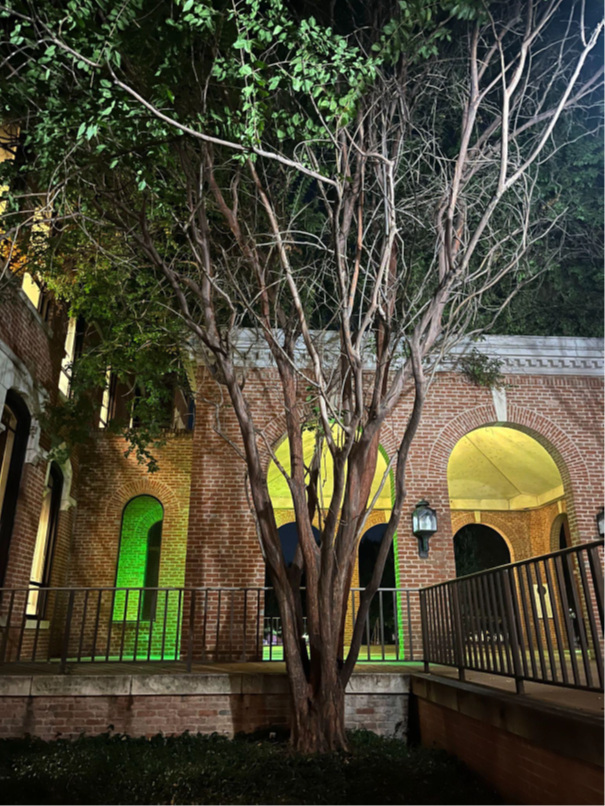
Even though I walk by the tree and the cats daily, it is rare to see them interact beyond the cats just using it for shade. I was often left wondering if there was a deeper relationship between the two than simply as protection from the sun. This wonder turned into awe on one fateful night this past semester, as I ventured to the courtyard to sit and reflect. When I arrived, I noticed one of the cats climbing along the winding trunks and branches, reflecting the notion of pure innocence that I had previously noted as being historically attributed to the Crape Myrtle. I watched this cat explore with intention, and I had tried to place myself within his imagination as he played. I felt that he was envisioning winding paths through a dark forest, climbing through the leafy growth at the top of the many trunks. I watched as he expressed joy leaping from trunk to trunk, unaware that I was present and watching. As I watched the cat play I reflected upon how the tree has watched this family grow together, a beautiful image of God’s creation watching over and protecting the creatures that inhabit the Earth. I thought of the countless students the tree has silently observed as well, alongside the family of cats.
I connected the cat’s navigation of the many branches with the student experience, as we are navigating the many possible paths we could take to guide our lives. Having made this observation, I was reminded of Christina Rossetti’s poem A Dumb Friend. Rossetti, as an Anglo-Catholic, often emphasized the theme of creation within her work. She advocated for acknowledgement of all of God’s creation, rejecting the popular notion that it was reserved for humans to subdue in the name of utilitarianism. I am inspired by this view, and have begun to view my tree as “A faithful pleasant friend, who year by year / grew with my growth and strengthened with my strength” (Rossetti lines 21-23). The tree has always been there watching both the students and the cats, serving as a metaphorical roadmap for our human futures, and as a medium of which the cats can connect with creation and their Creator. Having adopted more of Rossetti’s worldview prior to this interaction, I was able to view this moment with much greater depth and clarity than I otherwise would have. This has led me to compose an exploration of the cats’ relationship with the tree as a means of connecting with God, further deepening my appreciation for creation within my own life.
Leaves
Introduction
Building on my experience observing the cat and the tree that one night, I dove deeper into my study of Rossetti and her view of creation. I was drawn to her poem All Works Praise Thee, O Lord: A Processional of Creation where she places all of creation on a relatively equal plane underneath the Lord. When I read the lines “All creatures sing around us and we sing: / We bring our own selves as our offering” (Rossetti, lines 150-153) I found myself in my head once again among the tree and the family of cats, together in communion as creation that worships the Lord. In my short story, I seek to convey to the reader how other living beings of creation seek to worship as we do, however they find it through different outlets. In my story, the tree serves as this medium for the protagonists, Bao and Arthur. Bao is Arthur’s uncle, reserved and stoic. Arthur is young and curious, and is able to crack Bao’s shell after he expresses his interest in the tree. I believe it is a story that Rossetti would have loved to have read, as it is a creative envisioning of her view of creation expressed in her many works of poetry.
Creative Response
Living Creation Synchronous in Worship
Works Cited
Rossetti, Christina. “A Dumb Friend.” The Complete Poems of Christina Rossetti. Penguin Classics, 2001.
Rossetti, Christina. “‘All Thy Works Praise Thee, O Lord’: A Processional of Creation.” The Complete Poems of Christina Rossetti. Penguin Classics, 2001.