

The Living Witness
Tree Tag #2738 on Baylor's Sustainability Map
By Neena Chakkathara for Dr. Joshua King's ENG 2301: British Literature class, Fall 2025
This reflection is part of a series of “Tree Stories” by Baylor students that take root in their observations about a tree on campus, branch into connections between their tree and their experiences and education, and leaf out into a creative response to the tree.
Welcome
I hope that as you read this story, you come to see my Live Oak the way I have come to see it, not just as a landmark on Baylor’s campus, but as a steady presence that quietly witnesses the joy, struggle, growth, and transformation of the students who pass beneath its branches. My goal is to invite you into the sense of continuity, calm, and connection that this tree has offered me.
Roots
When I first encountered my Texas Live Oak, I felt an immediate sense of calm that made me stop and stand beneath its wide, sheltering crown. The tree rises about thirty feet into the air, its fifty-foot spread curving slightly downward like an embracing arm. According to the Baylor tree app, its trunk ranks in the top eight percent of DBH measurements, signaling just how steadily it has grown through decades of change. I didn’t choose this tree because of its ranking or size, though those details came later. I chose it because of how it felt. It seemed ancient and alive at the same time, as if its branches held stories from seasons I could not see but sensed all around me.
Learning more about the Live Oak’s species deepened what I already felt intuitively. Quercus virginiana is native to the southern United States, known for its dense wood and resistance to decay. Its timber famously strengthened “Old Ironsides,” giving the tree a history tied to endurance and resilience. These qualities helped me understand why the tree felt so grounding. The Live Oak’s survival through storms, drought, and human development gives it a quiet authority, an ability to persist without demanding attention.
This persistence reminded me of the tree in The Dream of the Rood, where the speaker tree endures suffering with unwavering strength. The Cross describes Christ as a “young hero… strong and firm of purpose” (Caedmon 39–40), a portrayal that highlights endurance as a sacred act. Like the Rood, my oak stands firm through time, its strength measured not by domination but by steadfastness. That quiet durability is what continues to draw me back to it.
Branches
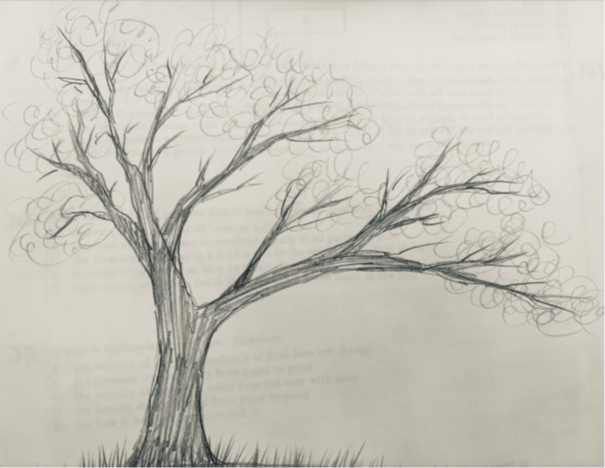
Over the semester, the most formative moment I had with my Live Oak occurred not during a quiet afternoon but during one of the busiest hours between classes. Students poured across Fountain Mall, voices layering over one another, backpacks bouncing, music echoing from someone’s speaker. I sat beneath the oak’s broad canopy and watched the sunlight shift between its long limbs. In that moment, I suddenly became aware of how many students had passed beneath this exact stretch of branches over the years, how many feet had worn the grass, how many conversations had drifted upward and dissolved into the leaves.
It felt almost as though the tree held these passing moments, not in a literal memory but in the quiet grounding presence it offers to anyone who pauses beneath it. I realized I was sharing space with decades of students who had found shade here, cried here, laughed here, or simply breathed here between one responsibility and the next. My earlier reflections had focused on the tree’s physical sturdiness, but this moment helped me see its emotional endurance.
Reflecting on this experience, William Wordsworth’s Yew-Trees came to mind. Wordsworth describes the yew as “a living thing / Produced too slowly ever to decay” (lines 10–11), a being shaped by time rather than movement. Although my Live Oak feels more vibrant than Wordsworth’s grave and ghostly yews, his understanding of trees as witnesses resonated. The Live Oak does not simply stand in place, it absorbs the energy of campus life and quietly anchors it. Its stillness does not oppose motion; it frames it.
Craig Santos Perez’s Family Trees deepened this interpretation. In that poem, trees serve as elders, linking people across generations: “Listen, i tronkon Nunu calls us to link our hands!” (stanza 6, line 6). That idea, trees as connectors, echoed what I had felt beneath the Live Oak. The oak draws together people who may never meet: the students before me, beside me, and after me. By simply existing, it becomes a thread woven through countless personal histories.
This moment helped me understand my tree not just as a symbol of strength but as a living witness to continuity. It stands at the center of academic stress, friendships, heartbreaks, beginnings, and endings. It observes without judgment, offering the same steady presence to every person who sits beneath it. This realization I had is what inspired the creative story that follows.
Leaves
Introduction
My creative response is a short story inspired by Craig Santos Perez’s understanding of trees as connectors of memory and ancestry in Family Trees. Perez’s line, “i tronkon Nunu calls us to link our hands!” (stanza 6, line 6), captures the idea that trees draw people together across time, forming a living thread that connects generations. This approach directly influenced how I structured my story. Instead of writing from a single perspective, I chose to focus on three different Baylor students from different backgrounds, each of whom interacts with the same Live Oak at key moments in their lives. Although the students never meet one another, the tree silently links them, becoming a shared point of reflection, comfort, and grounding.
Perez’s blending of memory and continuity helped me imagine the Live Oak not only as a witness but as a quiet keeper of experiences. Like Perez’s trees, which carry ancestral presence, the Live Oak in my story absorbs the emotions and transitions of the people who come to it. The story also pulls from the sense of endurance found in The Dream of the Rood, as well as the stillness and observation central to Wordsworth’s Yew-Trees. By combining these influences, I aimed to create a work of prose that illustrates how one tree can become a site of connection for students who are each navigating different forms of struggle and growth.
Using the medium of prose allows me to explore distinct voices and scenes across time while maintaining the unity of place. This way, the Live Oak becomes both a literal and symbolic anchor for the three narratives that follow.
Creative Response
Works Cited
“Yew-Trees by William Wordsworth.” Famous Poems, Famous Poets. - All Poetry, allpoetry.com/Yew-Trees.
“Family Trees, by Craig Santos Perez.” World Literature Today, 1 Oct. 2019, worldliteraturetoday.org/2019/autumn/family-trees-craig-santos-perez.
Dream of the Rood | Old English Poetry Project | Rutgers University. oldenglishpoetry.camden.rutgers.edu/dream-of-the-rood.