

Red Oak
Tree Tag #2029 on Baylor's Sustainability Map
By Chris Barmore for Dr. Joshua King's ENG 2301: British Literature class, Fall 2025
This reflection is part of a series of “Tree Stories” by Baylor students that take root in their observations about a tree on campus, branch into connections between their tree and their experiences and education, and leaf out into a creative response to the tree.
Welcome
I hope that readers take away from this that trees are organisms that mirror a lot of aspects of humans, which reflects how all of creation is made in the image of God, like humans.
Roots
The tree that I chose is this Red oak/Shumard oak tree next to the parking lot of Simpson athletic facility. I chose this tree because it is a tree that I encounter almost every day, using it for shade when I park. This tree is a part of a set of other Red oaks that line this section of the parking lot. I make an effort every time I park in the parking lot to find a spot with shade and these trees provide it and I am grateful that these trees are there. When it was mentioned in class that most of us were drawn to the bigger trees, it made me be drawn towards picking a tree that wasn’t one of the bigger trees. However, these Red oaks provide the perfect amount of shade to keep my car cool, which makes me wonder why more people that park in this parking lot aren’t drawn towards parking under them.
Something that is interesting to me when I looked into its history is that these kinds of trees are large and grow up to 100 feet, while the ones in this group are only 15 feet. I assume that the growth of these trees is controlled due to where they chose to plant these. It is interesting that they chose this kind of tree to plant here since it is known for being one of the larger red oaks. Looking at this specific tree, you can see where some of the branches were pruned lower on the trunk, most likely to give the trees a uniform look. It is also visually interesting that these trees have a lot of ridges. I also like how these trees have a decent amount of branches coming off the main trunk, which helps with providing shade.
My tree relates to William Cowper’s “The Poplar Field” due to how I use it for shade. He mentions “The poplars are fell'd; farewell to the shade,” which describes how the trees he once enjoyed are gone now so he can’t use it for that anymore, therefore “the tree is my seat that once lent me a shade”. If these trees disappeared, it would affect a good amount of people without them even realizing how beneficial these are.
Branches
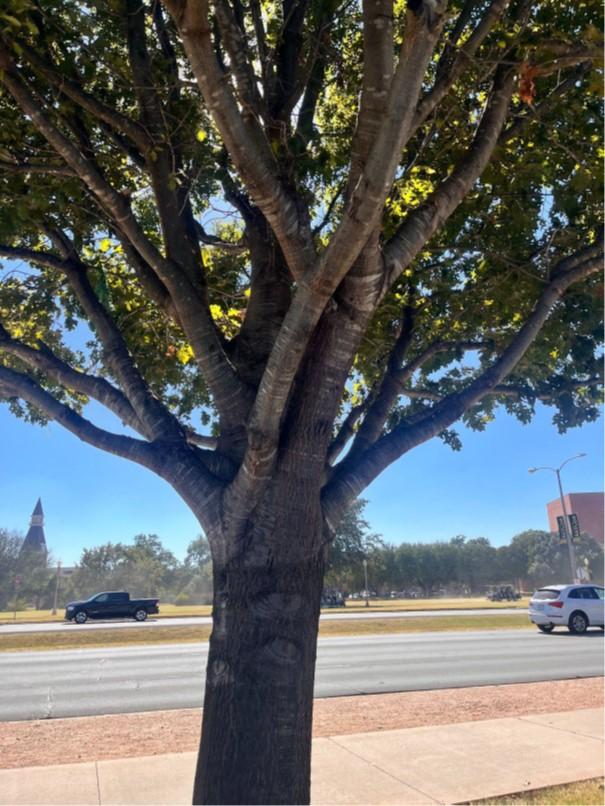
For this visit to my tree, I wanted to see how much it has changed since last time, since we are in a transition period of the seasons so I figured it would have noticeable differences. This also came to mind because of the few cold weather days recently and how using these trees for shade isn’t as important. Without this project, I would not have consciously thought much about how since it was cold I chose to park in the sun instead of under the trees, and it goes to show how quickly the trees we use can go unappreciated. Regarding the changes to the tree, while some of the leaves are brown, the majority of them are still green so there is probably a good bit of time before the leaves start dropping. What stood out to me were the acorns that started to fall. There are remnants of a lot of slightly older acorns that are just shells now, however there are a few that are freshly fallen. This stood out to me because these trees are sandwiched between a busy street and a parking lot, so they are kind of isolated from other wildlife, most likely reducing the amount of squirrels and other animals that can take advantage of these acorns.
Seeing these acorns also reminded me of Julian of Norwich’s vision of the hazelnut, where she has a vision while holding a hazelnut, and she sees it as all of creation. It symbolizes how from God’s view, creation is something so small and fragile, that continues to survive because it is cared for. While they aren’t the exact same thing, they are both the seeds of trees and are of similar size. The many shells of other acorns also connect to this vision due to the fragility of the shells, as ‘though it might have crumbled to nothing, it was so small’. It made me think of how even though the trees around campus are fully controlled so that new trees aren’t going to grow unintentionally, the trees are still going to do their thing and produce plenty of seeds. These acorns connect to how the hazelnut in the palm of her hand is ‘all that is made’, being the seed of a potential whole new tree.
Leaves
Introduction
For my next visit to my tree, I wanted to see how much the tree has changed due to the weather. This was on my mind because it is December now and we are having cold weather now. Last time, I noted how it was getting slightly cooler so I noticed how the leaves were still green. What I observed this time is that the leaves are starting to get brown. Specifically, the edges of the leaves are brown and the green in the leaves isn’t as bright green as before. I also noticed how the acorns on the ground are pretty much all gone, which I assume is from the animals such as the squirrels coming by and taking them. These changes since last time brought my mind to Craig Santos Perez’s “We Aren’t the Only Species”, which talks about how us humans are not the only species that do different actions like “change”, “sleep”, “need”, etc. This came to my mind because just like how we have to adjust to the change in seasons, other species have to too. We change our clothing, our routines, etc., to adapt to the cold weather, while the trees adjust by dropping their leaves and other processes. Squirrels also have to adjust by collecting acorns for winter. We aren’t the only species “who change”.
Creative Response
1. A Tree's Purpose, 2. Potential, & 3. Adaptation
Works Cited
Texas A&M Forest Service - Trees of Texas - List of Trees, texastreeid.tamu.edu/content/TreeDetails/?id=106&t=O. Accessed 15 Oct. 2025.
William Cowper, “The Poplar Field”
Julian of Norwich. “Chapter 5.” All Shall Be Well: Daily Readings from Julian of Norwich, Revelations of Divine Love, by Sheila Upjohn, Morehouse Publishing, 1992
Santos Perez, Craig. “We Aren’t the Only Species”