

Striking Trees and Falling Leaves
Tree Tag #3144 on Baylor's Sustainability Map
By Pia Dooley for Dr. Joshua King's ENG 2301: British Literature class, Fall 2025
This reflection is part of a series of “Tree Stories” by Baylor students that take root in their observations about a tree on campus, branch into connections between their tree and their experiences and education, and leaf out into a creative response to the tree.
Welcome
Over the past semester, I have admired one tree in particular. It stuck out to me on the first day of class and I sent a picture of it to my mom. The main thing I saw in the tree was solely how pretty I thought it was, but after a closer consideration, I realized the tree provided more things than just beauty. I found further appreciation within this tree, which led me to reevaluate past interactions I had with trees throughout my life. I hope my tree story will impact others to appreciate trees they encounter.
Roots
Over the past semester, I have admired one tree in particular. It stuck out to me on the first day of class and I sent a picture of it to my mom. The main thing I saw in the tree was solely how pretty I thought it was, but after a closer consideration, I realized the tree provided more things than just beauty. I found further appreciation within this tree, which led me to reevaluate past interactions I had with trees throughout my life. I hope my tree story will impact others to appreciate trees they encounter.
Branches
Within my encounters with the catalpa tree, one moment of realization stuck out to me the most. It connected to the day where I sat with my tree. The sound of the leaves falling reminded me of the sound of waves crashing on the beach. The same noise I’d hear as a child when I would swim in the ocean all day and become so tired that I would just lay in the sand. This moment along with what I realized a few days later was what struck me. Which was the fact that the tree had, by now, almost completely shed all its leaves. I had been so aware of the sound of the tree, that I forgot to take a good look at it to notice the amount of leaves that had fallen off. A tree shedding its leaves is something everyone knows about, and it’s perhaps the most normal thing for a tree to do. Yet I had such a large reaction to the branches being left bare on the tree. A tree that I passed by everyday had endured so much change, and it signified how much time had gone by. To me, this semester had felt like it flew right past me, almost flowing past me just like the leaves blew off the tree. This tree provided a visual representation of how much time truly had gone by. I was shown a visual representation of time through the bareness of leaves on this tree. Almost as if this tree changed over the semester as I did, grew as I did. I found a reading from class that had captured this experience the best was “Our Casuarina Tree” written by Toru Dutt, a nineteenth-century poet from British India. Where a few lines of the poem describe her memories of playing with family being tied to a tree, “But not because of its magnificence/ Dear is the casuarina to my soul:/ Beneath it we have played; though years may roll” (Dutt lines 23-25). Initially when reading this, I didn’t think I could relate to the feeling of having a tree dear to one’s soul. However, I now can understand what the author meant by that. The feeling of a tree standing tall and setting its place within one's memories while the years go on is striking. This impression is what I experienced with my catalpa. Even though I’ve admired this tree for only this fall semester of my sophomore year, it still holds significance to me–Dutt’s poem helped me deepen my understanding of trees to lead me to this conclusion.
Leaves
Introduction
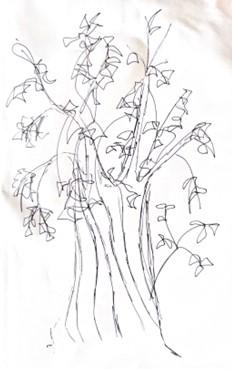
The creative response I have chosen is depicting my tree through the medium of color pencils, oil pastels, and watercolor. I chose this route because I believe the medium in which something is presented can leave a large impact on the message. A reading that inspired me to depict my catalpa through art was by Julian Norwich titled, The Revelations of Divine Love. The meditation follows a woman who is shown creation in a tangible form. Yet it is not something large and complex, it is just a small seed. “And then he showed me a little thing, the size of a hazelnut, in the palm of my hand - and it was as round as a ball. I looked at it with my mind's eye and I thought: 'What can this be?' And answer came: 'It is all that is made.'... I thought it might have crumbled to nothing, it was so small” (Norwich 4). This passage follows that creation, something so large and complex, can be reflected within something as small as a seed. Specifically a hazelnut seed, which you would plant to grow a tree. The perspective of seeing creation through a hazelnut seed is most likely the view of creation from God’s perspective. Which can highlight the idea that creation is something that holds an ever greater capacity, where in this instance it would become a hazelnut tree. With a campus full of trees, if we focus on one small one, we can see the greater significance it holds. Similar to how Julian sees how a small thing can hold great significance– how if we just focus on one small thing, we can realize it holds potential. Maybe this tree on campus just provides shade for a nearby bench, or it holds an influential place in someone’s life. I chose to depict this tree in monochromatic tones to signify its simplicity, how the tree stands rather than the different colors it has. In addition to the color, there are also leaves falling and the fruits of the tree drooping down, similar to how Julian of Norwich recalled the hazelnut seed. These fruits will fall and one day become seeds that will grow new trees, and new encounters from students on campus.
Creative Response
Works Cited
Dutt, Toru. “Our Casuarina Tree.”
Norwich, Julian of. All Shall Be Well: The Revelations of Divine Love of Julian of Norwich.
“Trees of Texas Southern Catalpa.” Texas A&M Forest Service - Trees of Texas - List of Trees, texastreeid.tamu.edu/content/TreeDetails/?id=25.