

The Tenants Of The Oak
Tree Tag #1439 on Baylor's Sustainability Map
By Mithran Muthukumar for Dr. Joshua King's ENG 2301: British Literature class, Fall 2025
This reflection is part of a series of “Tree Stories” by Baylor students that take root in their observations about a tree on campus, branch into connections between their tree and their experiences and education, and leaf out into a creative response to the tree.
Welcome
Welcome! We often look at trees, but we rarely see them. I hope my story shows you that this Live Oak isn't just a plant growing next to Morrison Hall. It is a survivor, a protector, and a home. I hope this story makes you pause the next time you walk by a tree and realize that while we are just passing through, they are the true guardians of our campus.
Roots
There is a Live Oak (Quercus virginiana) next to Morrison Hall that has been a part of my Baylor life since freshman year. I didn’t choose it at first. It was simply there. I always parked my bike under it because it kept it dry when it rained. Over time, I started to notice it more. I liked sitting on the bench nearby after class because the tree’s shade always felt cool. Now, in my final semester, I realize I have spent more time around this tree than almost any other spot on campus.
The tree looks old. Its branches stretch wide and low, almost like it’s reaching out to protect everything underneath it. It feels like it’s been watching over this place for decades, maybe even longer. I like to imagine all the students before me who probably sat here, thinking about where their lives were going. There’s something calming about this tree. No matter what changes around campus, this tree always stays the same.
According to the Texas A&M Forest Service, the Live Oak is native to the south and can grow its crown up to 100 feet wide. Historically, these trees were used for shipbuilding because they are tough and resist decay. Knowing this, the tree feels like more than just a plant to me now. It is tied to human endurance. It reminds me of “A Dumb Friend” by the nineteenth-century British poet Christina Rossetti. Like the friend in the poem, this tree never speaks, yet it feels patient and dependable, always ready to provide shade when needed.
Branches
In my first reflection, I compared my tree to "a dumb friend." I thought it was just an object that existed in the background. But spending more time with it has changed my mind. One day, I was eating lunch under it and felt very safe. The sounds of campus got quiet. The big branches above me felt like a shield. This tree felt old and wise, like a protector or guardian.
This realization made me think of our class reading, “The Dream of the Rood,” an old Anglo-Saxon poem. In the poem, the Rood is a tree (the cross) that seems to speak of everything it has seen. It was a quiet watcher that was forced to be part of a story. It holds many secrets about what it saw. My tree on campus also seemed to be a quiet watcher. It has gone through many seasons. It has also watched lots of students walk by, all of them carrying their own heavy problems. The Rood is a symbol of strength, but it got that strength by going through hard times. The Rood says, "More than enough foes made me stand fast." When I look at my tree, I see its rough bark and strong roots. These are like scars from its own hard times. It has lived through hot summers and storms. I remember during the 2021 winter, they cancelled classes because it snowed. But my tree must have still stood outside during this period. It endured the cold just like the Rood endured the hill.
However, my view shifted again recently. I was sitting under the tree thinking about home and the time I had spent with family during Thanksgiving break. As I was reflecting on my break, I began to notice how the smaller saplings nearby seemed to curl toward the larger oak. It didn't look like random growth. It looked like a family gathering. I realized that this tree isn't just an isolated object near Morrison Hall. It feels like the Live Oak is an elder in a community of living things.
This moment connected perfectly with "Family Trees," a poem by Craig Santos Perez, a contemporary Chamoru writer originally from Guam. He writes that the character calls "forth the names / of each tree, each elder, who has provided" them. Reading this changed my perspective. I used to think of the tree as just "a dumb friend" or a quiet watcher. But now, I see it as a historian. When I sit under those heavy branches, it feels like I am stepping into its home. Just like how we try to honor our past and our traditions in my own culture, this tree is standing there, acting as an elder for the saplings, remembering everything that came before it.
Leaves
Introduction
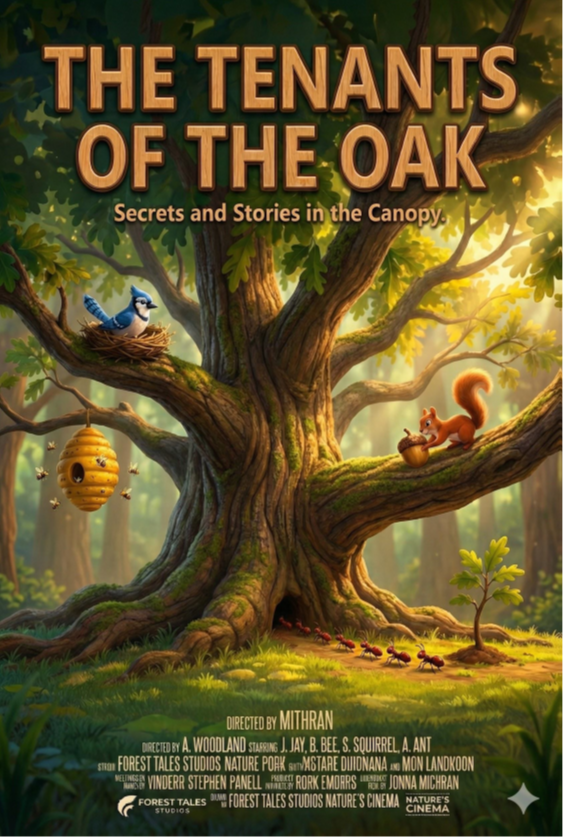
For my creative response, I decided to write a short screenplay titled The Tenants of the Oak. Since I love screenwriting, I felt this was the best medium to visualize the personality of the tree. I used a fable-like structure, similar to Pixar movies, to show the social hierarchy within nature. The characters represent different groups in society. Sterling, the bird, represents privilege. Cash, the squirrel, represents those who hoard resources. The Bees represent the wealthy producers. The Ants represent the working class, while Sprout, the sapling, represents those in poverty. They’re all on different branches. Each branch resembles a different level on the socioeconomic ladder.
This story follows the same journey as my reflections. In the beginning, the animals treat the tree as a "A Dumb Friend" (Rossetti). To them, it’s just a stage for their fights or a place to store their stuff. It is silent and passive. However, when the storm hits, the story shifts to the imagery of The Dream of the Rood. The tree becomes a suffering survivor. It physically twists to shield the animals, enduring the wind so they don't have to.
By the end, the story connects to Craig Santos Perez’s "Family Trees." The animals realize the tree isn't just wood. It is a wise elder that holds their community together. I chose to make the tree the narrator to give it a voice, revealing that while the world rushes around it, the tree is the silent, ethical foundation for everyone living in its branches.
Creative Response
Works Cited
Christina Georgina Rossetti. “A Dumb Friend.” Poem: A Dumb Friend By, www.poetrynook.com/poem/dumb-friend. Accessed 15 Oct. 2025.
Dream of the Rood | The Poetry Foundation, www.poetryfoundation.org/poems/159129/dream-of-the-rood-translation. Accessed 12 Nov. 2025.
Perez, Craig Santos. "Family Trees." Habitat Threshold, Omnidawn Publishing, 2020.
Texas A&M Forest Service - Trees of Texas - List of Trees, texastreeid.tamu.edu/content/TreeDetails/?id=109. Accessed 15 Oct. 2025.
Tolkien, J.R.R. The Hobbit. Houghton Mifflin Harcourt, 2012.